Prop Bets for NFL: The Complete Analytical Guide for British Punters
 Available in US
Table of Contents
- What Nine Years of Prop Analysis Taught Me in Five Bullets
- Why Prop Betting Deserves Its Own Playbook in the UK
- What Proposition Bets Actually Are and What They Are Not
- The Three Families: Player, Team and Game Props
- How the UK Prop Landscape Differs From the US Market
- Reading the Lines: Decimal Odds, Implied Probability and Vig
- The UKGC-Regulated Bookmaker Environment
- The Prop Markets British Punters Actually Use
- Strategy Foundations: Where Prop Edge Comes From
- Staking Discipline for Prop Punters
- Live Props and Bet Builders: The Modern Toolkit
- Super Bowl and London Games: The Two UK Prop Peaks
- Risks, Integrity and Responsible Play
- Frequently Asked Questions
Data-backed prop insights for UK punters
By NFL Prop Betting Analyst

What Nine Years of Prop Analysis Taught Me in Five Bullets
- Props account for 15-20% of NFL handle at online sportsbooks and carry higher margins than spreads or totals — know the overround before you bet.
- The UK’s 14.3 million NFL fans operate under a single UKGC regulatory framework with decimal odds and no tax on winnings — a materially different environment from the US market.
- Anytime touchdown scorer, passing yards and receiving yards are the three most popular player prop markets; quarterback passing yards offers the best starting point for analytical beginners.
- Edge comes from informational speed, contextual reads and structural inefficiency in low-volume markets — not from star names or gut feelings.
- Staking discipline is non-negotiable: 1-2% of bankroll per player prop, lower for exotics, and every bet tracked in a spreadsheet for honest review.
Why Prop Betting Deserves Its Own Playbook in the UK
Three seasons ago I placed my first NFL prop bet at a UK sportsbook — a passing yards over on a Thursday night game that kicked off at half past one in the morning, British time. I won, barely, and the rush was nothing like backing a team to cover a spread. I was betting on one man’s arm against one defence’s secondary, and I had done the homework that the line had not accounted for. That single bet changed the way I approach the NFL entirely.
I am far from alone. The United Kingdom is home to roughly 14.3 million NFL fans — nearly one in five British adults — and that number has been climbing every autumn since the London games became a fixture on the calendar. Sky Sports viewership of live NFL rose 34% year on year through the most recent season, and prop markets have tracked that growth almost stride for stride. The bookmakers have noticed: prop menus at major UK sportsbooks now routinely list fifty or more individual markets per game, covering everything from quarterback passing yards to the colour of the Gatorade shower at the Super Bowl.
Yet most guides treat props as a footnote inside a broader NFL betting overview, or they are written for an American audience dealing with American odds, state-by-state regulation and apps that do not exist in the UK. British punters operate in a different environment — decimal odds, UKGC-licensed operators, no college player props, different tax treatment, different kickoff times. That gap is what this guide exists to fill.
This is not a list of “best bookmakers” or a collection of tips for this weekend’s slate. The goal is to give you a framework — the knowledge, the maths and the habits — so you can evaluate prop markets on your own terms, every single week of the season.
I will walk through what proposition bets are, how the three prop families differ, where the UK market diverges from the US, how decimal odds translate into implied probability, which markets British punters actually use, how to build a repeatable strategy, and where the real risks sit. If you have ever stared at a prop sheet and felt overwhelmed, this is the playbook.
What Proposition Bets Actually Are and What They Are Not
I once tried explaining prop bets to a mate who had only ever backed accumulators on Premier League results. His first reaction: “So you’re betting on stuff that doesn’t affect who wins?” That is close enough to be useful and wrong enough to be dangerous. A proposition bet is a wager on a specific occurrence — or non-occurrence — within a sporting event, rather than a wager on the final result of the event itself. The word “proposition” is the clue: someone proposes a scenario, sets a line, and you decide whether the real outcome will land above, below, or on that line.
Proposition bet (prop bet) — a wager tied to a specific in-game event, player performance threshold or statistical outcome, independent of the match result. Examples include a quarterback’s passing yardage, total field goals in a game, or whether a particular player scores a touchdown.
The concept dates back further than most people realise. The first widely recognised prop appeared at Super Bowl XX in 1986, when a Las Vegas sportsbook offered odds on whether William “The Refrigerator” Perry — a 150-kilogram defensive lineman moonlighting as a goal-line ball carrier — would score a touchdown. He did. Forty years later, props represent an estimated 15 to 20% of total NFL handle for online bookmakers, with higher hold margins than traditional side and total bets.
What props are not: they are not futures (season-long outcomes like MVP), not standard match lines (spreads, moneylines, game totals), and not novelty bets by default — although novelty markets like the coin toss do fall under the prop umbrella at the Super Bowl. The common thread is specificity: a prop isolates one measurable variable and asks you to take a position on it.
Max Bichsel of the Gambling.com Group described the convergence of sports, media and betting as “a once-in-a-lifetime event.” That collision is most visible in the prop market, where every yard, every catch and every sack has been turned into a tradeable line.
For UK punters, the practical implication is straightforward: props let you apply granular knowledge — about a player’s usage, a defensive scheme, a weather forecast — in a way that broader match markets never can. If you know more about a running back’s workload share than the line implies, you have an angle. If you do not, you are adding entertainment value, which is perfectly valid but a very different proposition from seeking long-term profit.
The Three Families: Player, Team and Game Props
A few years into my prop analysis work, I started keeping a spreadsheet that tagged every bet I placed by family — player, team or game. After two full seasons the split was roughly 70% player, 20% team, 10% game. That ratio is not unique to me. Across the industry, player props dominate the market by handle and by menu depth, with anytime touchdown scorer consistently ranking as the single most popular player prop at major sportsbooks, followed by receiving yards over/under and first touchdown scorer.
The three families are not just categories on a menu. They represent fundamentally different analytical challenges, different variance profiles, and different edges.
| Characteristic | Player Props | Team Props | Game Props |
|---|---|---|---|
| Unit of analysis | Individual player performance | One team’s aggregate output | Combined game-level event |
| Typical markets | Passing yards, rushing yards, receptions, anytime TD, interceptions | Team total points, first team to score, team sacks | Total TDs in game, race to 10 points, longest play |
| Key edge source | Matchup analysis, usage data, injury news | Game script projection, pace-of-play | Combined tempo analysis, scoring environment |
| Variance level | High (single-player dependency) | Moderate | Lower (aggregated outcomes) |
| Menu depth at UK books | Deep — 30+ markets per game | Moderate — 8-15 markets per game | Narrow — 5-10 markets per game |
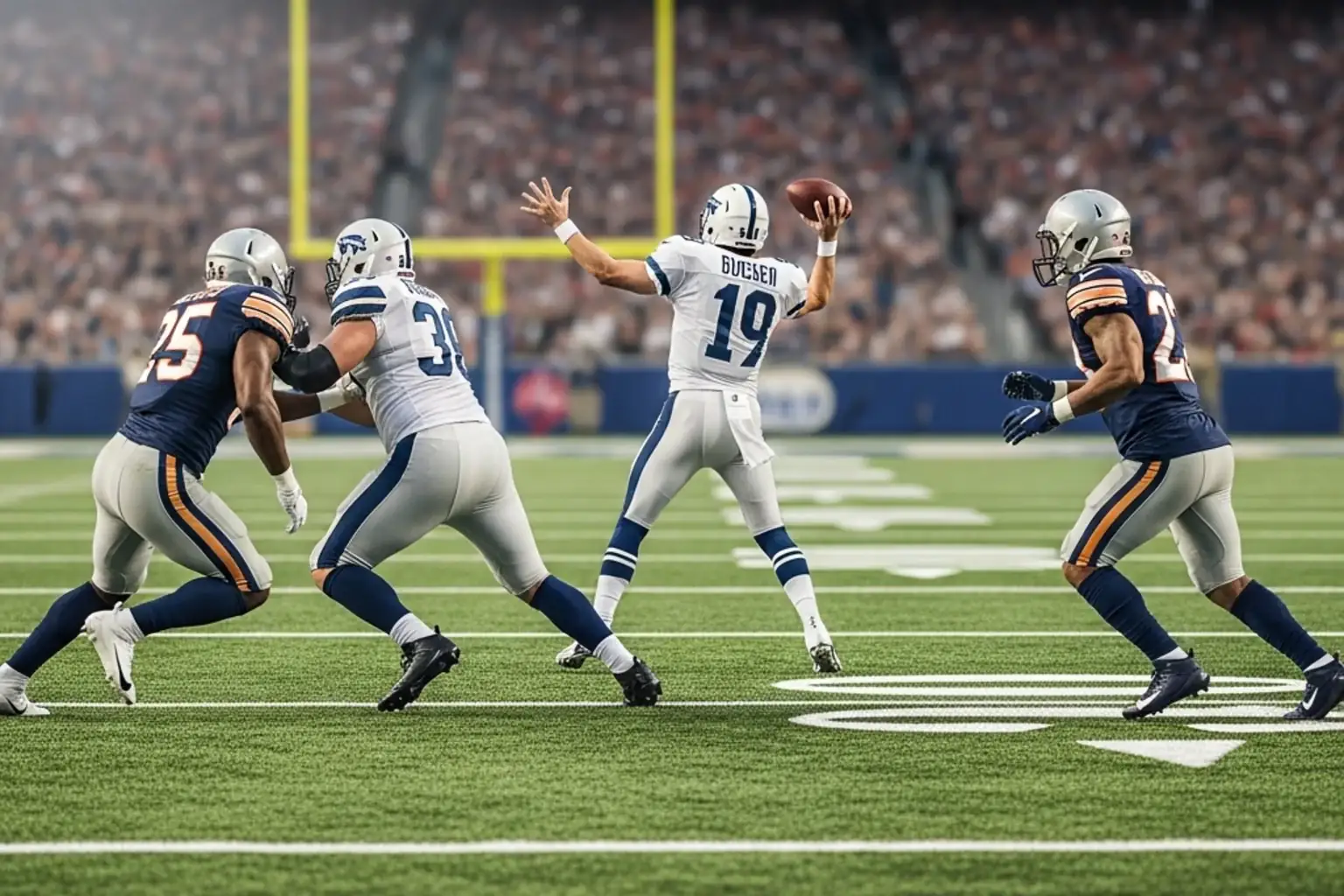
Player props are where most UK punters start and where most of the analytical edge sits. When you bet on a quarterback’s passing yards, you are modelling one player’s volume against one defensive unit, filtered through game script, weather and pace. That is a narrower problem than predicting a match outcome, and narrower problems are easier to solve well.
Team props occupy the middle ground. A “team total points over 23.5” bet requires you to project offensive output without worrying about the opponent’s score. These markets correlate closely with game totals and point spreads, so the lines tend to be sharper — bookmakers derive team totals from their existing game-line models.
| Market | Line | Over | Under |
|---|---|---|---|
| QB Passing Yards (Player) | 274.5 | 1.87 | 1.93 |
| Team Total Points (Team) | 23.5 | 1.91 | 1.91 |
| Total TDs in Game (Game) | 5.5 | 1.83 | 2.00 |
Game props — total touchdowns scored, whether either team reaches 20 points first, the longest scoring play — aggregate across both teams. The analytical challenge shifts: you are capturing the overall texture of a contest rather than isolating a player, and the bookmaker’s game-level model is usually their strongest product. Finding mispriced game props is hard.
Where you concentrate your research time matters. Player-level analysis — target shares, snap counts, defensive matchup grades — most frequently uncovers lines that lag behind public information. Team and game props reward different attention: pace trends, coaching tendencies, situational scripting. Knowing which family you are working in shapes every decision that follows.
How the UK Prop Landscape Differs From the US Market
When I first started reading US-focused prop analysis, I kept running into advice that simply did not apply. “Shop DraftKings against FanDuel.” “Check your state’s regulations.” “Watch for college player prop edges on Saturdays.” None of that translates to the British market, and the differences go deeper than just which apps are available on your phone.
| Dimension | UK Market | US Market |
|---|---|---|
| Odds format | Decimal (e.g. 1.91) | American (e.g. -110) |
| Regulatory body | UK Gambling Commission (single national licence) | State-by-state licensing (50+ jurisdictions) |
| Tax on winnings | None — operators pay the tax | Winnings are taxable income federally |
| College player props | Not offered | Available in many states |
| Prop availability window | Often 48-72 hours pre-game | Lines posted earlier at some books |
| Exchange betting on props | Available (limited) | Rare / not widely available |

The odds format difference is cosmetic but matters for workflow. Every piece of US prop content quotes lines as “-115” or “+130,” and if you are not fluent in converting those to decimal, you will misjudge value. The headline is simple: decimal odds show your total return per pound staked, American odds show how much you risk or win on a notional hundred-unit base. UK punters think in decimals — do not fight it.
Roughly 10% of the UK adult population actively participates in online sports betting. That is a mature, saturated market with sophisticated operators — and it means prop lines at UK books are not soft. The edges exist, but they require work.
The regulatory picture is the more consequential difference. In the US, sports betting law is a patchwork — legal in some states, illegal in others, with different rules about what props can be offered. In the UK, a single UKGC licence covers all of England, Scotland, Wales and Northern Ireland. Every licensed operator follows the same advertising codes, affordability checks, identity verification and dispute resolution pathways. You do not need to worry about whether your sportsbook is legal in your postcode.
The UK sports betting market generates approximately GBP 2.48 billion in annual gross gambling yield, reflecting how deeply embedded wagering is in British sporting culture. NFL’s share is small but growing fast, driven by the London games, expanded Sky Sports coverage and a generation of fans who discovered the sport through social media and fantasy leagues.
One more practical difference: exchange betting. In the US, peer-to-peer wagering on props barely exists. In the UK, exchange platforms allow you to lay props — to take the bookmaker’s side — on certain NFL markets. The liquidity is thin, but the option changes the strategic calculus for punters who understand how to use it.
Reading the Lines: Decimal Odds, Implied Probability and Vig
I have lost count of the times a fellow punter has told me they “got great odds” on a prop without being able to tell me the implied probability of the line. If you cannot convert a decimal price into a percentage in your head, you are flying blind — and the bookmaker is the only one with the instrument panel.
Decimal odds are the standard at UK sportsbooks and the simplest format to work with. A price of 1.91 means that for every GBP 1.00 you stake, you receive GBP 1.91 back if the bet wins — your original pound plus 0.91 in profit. A price of 2.50 returns GBP 2.50 on a one-pound stake. The higher the decimal, the less likely the bookmaker believes the outcome is.
Converting decimal odds to implied probability
Formula: Implied probability = (1 / decimal odds) x 100
Suppose a passing yards over is priced at 1.91.
Implied probability = (1 / 1.91) x 100 = 52.36%
The bookmaker is telling you this outcome has roughly a 52.4% chance of happening, according to their model.
Now here is the catch. Run that same formula on the under — priced at, say, 1.93 — and you get 51.81%. Add the two: 52.36% + 51.81% = 104.17%. That extra 4.17 percentage points above 100% is the overround, also called the vig or the juice — the bookmaker’s built-in margin. On every two-way prop market, both implied probabilities sum to more than 100%, and that surplus is the price you pay for having someone take the other side of your bet.
| Side | Decimal Odds | Implied Probability |
|---|---|---|
| Passing Yards Over 274.5 | 1.91 | 52.36% |
| Passing Yards Under 274.5 | 1.93 | 51.81% |
| Overround | 104.17% |
Props typically carry a higher overround than mainline markets. A point spread might sit at 104-105%, while a player prop can hit 106-110%, and exotics push higher still. That means you need to be right more often just to break even. The hold is exactly why operators love props — and why calculating implied probability in under ten seconds is the single most important arithmetic skill in this discipline.
Understanding the numbers on the screen is one thing. Knowing whether the platform showing you those numbers is trustworthy is another — and that is where the UKGC framework comes in.
Prop Market Toolkit
Three calculators for player-prop betting: two-way market overround, edge finder against your own probability estimate, and Same-Game Parlay margin compounding.
Enter the Over/Under odds for a single prop market — get the implied probability of each side plus the overround (the book’s margin).
Compare the market’s odds against your own probability estimate — see the gap in percentage points and the expected value (EV) per stake.
Add the overround of each leg in a Same-Game Parlay — see how margins compound multiplicatively instead of adding up linearly.
The bookmaker’s real SGP margin is usually even higher due to correlation adjustments between legs (e.g. “QB Over yards” and “Team Over points” tend to move together) — this calculator shows only the pure compounding effect of margin, without a correlation adjustment.
The UKGC-Regulated Bookmaker Environment
A punter in Pennsylvania worries about whether his sportsbook app is legal in his county. A punter in London has a different concern: whether the operator sitting behind that app actually runs a tight ship. In the UK, the legal question is settled — if a sportsbook holds a UK Gambling Commission licence, it can serve customers across the entire country. The quality question, however, is wide open, and that is where your attention should sit.
The UK’s overall gambling industry — excluding the National Lottery — generated GBP 11.5 billion in gross gambling yield in the twelve months to March 2024, up 5.7% on the prior year. The remote sector accounted for GBP 6.9 billion, rising 6.9%, and online GGY climbed a further 8% to GBP 1.42 billion in Q2 2025 alone. The operators competing for your NFL prop bets sit inside one of the most commercially active and heavily regulated gambling markets on the planet.
The UKGC licence is not a rubber stamp. Licensed operators must comply with strict rules on advertising, affordability checks, identity verification, self-exclusion schemes and dispute resolution. Any operator found in breach risks fines, licence conditions or outright revocation. For punters, this framework provides a baseline of consumer protection that most international markets cannot match.
Bill Miller, head of the American Gaming Association, noted that record revenues across the US “demonstrate the broad appeal of regulated gaming markets.” The same logic applies in the UK with even more force: British regulation predates American legalisation by decades, and the compliance infrastructure is correspondingly more mature. That maturity shows up in areas that directly affect prop bettors — disputed-bet settlement speed, odds transparency, voided-bet policies.
In practice, stick to UKGC-licensed operators — there is no reason to use an offshore sportsbook when the regulated market offers deep menus, competitive prices and enforceable protections. The regulatory environment shapes the prop market itself: UKGC rules restrict certain novelty markets, require clear odds display, and mandate responsible gambling tools. For a deeper look at how UK bookmakers compare on market depth, margins and tools, that analysis is worth your time.
When evaluating any UK sportsbook for NFL props, check three things before anything else: active UKGC licence number, published terms for void bets and late scratches, and availability of a bet builder or same-game parlay tool. Everything else — welcome offers, interface design, app speed — is secondary.
The Prop Markets British Punters Actually Use
Every autumn I run an informal poll in a group chat of about forty UK-based NFL bettors. The question is always the same: “What was the last prop you placed?” The answers barely change year to year. Anytime touchdown scorer. Passing yards over. First touchdown scorer. Receiving yards. That is the British prop punter’s core rotation, and the industry data confirms it — anytime touchdown scorer is the most popular player prop market by handle at major sportsbooks, with receiving yards over/under and first touchdown scorer rounding out the top three.
Anytime Touchdown Scorer
The gateway prop for most UK punters. Simple premise: will this player score a TD at any point in the game? High margin, high volume, enormous menu.
Passing Yards Over/Under
The quarterback market. A line is set on total passing yards; you bet whether the QB finishes above or below. Driven by game script, pace and defensive scheme.
Receiving Yards Over/Under
Target share is king. A receiver’s yardage line reflects expected targets, catch rate and route depth. Tight ends and slot receivers behave differently from perimeter wideouts.
First Touchdown Scorer
Higher variance, higher price. Correctly identifying the first player to cross the goal line pays significantly more than anytime TD, but the analytical burden is steeper.

What makes these four markets dominant in the UK is partly cultural and partly structural. British punters migrated to NFL from football, where anytime goalscorer is already the most popular player prop. The cognitive leap from “will Salah score?” to “will this running back score?” is short. Passing yards and receiving yards appeal to a more analytical crowd — the kind of punter who watches RedZone with a stats site open on a second screen.
Beyond the big four, the prop menu in the UK extends to rushing yards, reception counts, interceptions thrown, sacks recorded, kicker points and a handful of team and game-level markets. The depth varies sharply by operator. Some UK books list fifty or more props per game during primetime windows; others offer barely a dozen. That inconsistency is one reason line shopping matters so much in this space.
| Market | Example Line | Over / Yes | Under / No |
|---|---|---|---|
| Anytime TD Scorer — Starting RB | Score a TD | 1.62 | 2.20 |
| QB Passing Yards | 262.5 | 1.87 | 1.93 |
| WR Receiving Yards | 68.5 | 1.83 | 1.97 |
| First TD Scorer — Star WR | Score first TD | 8.00 | — |
Jeff Feazel of BetMGM pointed to the continued surge in same-game parlays as the defining recent trend, noting that high-scoring primetime games create particularly favourable SGP conditions. That observation underlines a broader shift: props are no longer standalone bets for most punters. They are building blocks, combined into multi-leg slips via bet builders. The standalone single prop still has a place — and it is arguably smarter from a pure expected-value perspective — but the market is moving toward combinations.
Point spreads remain the single most popular NFL market overall, favoured by 61% of bettors, with moneylines at 52% and totals at 47%. Props sit below those three but are growing faster than any of them. For UK punters, the practical question is not whether to bet props — you probably already do — but whether you are betting the right ones, at the right prices, with the right analytical framework behind them.
Strategy Foundations: Where Prop Edge Comes From
Here is a confession that took me years to make publicly: my first two seasons of prop betting were net negative. I was picking props the way most casual punters do — star players, gut feelings, whatever the podcast host recommended that morning. It was not until I sat down and built a simple spreadsheet model that I started to see where edges actually live. They do not live in star names. They live in the gap between what the line says and what the data says.
Prop markets carry some of the highest margins in the industry — higher than point spreads, higher than game totals. That combination of high volume and high hold is why bookmakers actively promote props. It is also why a disciplined analytical approach can still find value: the bookmaker’s prop model is strong, but it is thinner than the model behind a mainline spread.
Edge in prop markets comes from three primary sources, and understanding all three is what separates a punter who wins occasionally from one who wins consistently over a full season.
The first source is informational asymmetry. Prop lines are set by algorithmic models relying on historical data, recent performance and public injury reports. Those models update slowly. A backup running back elevated to the lead role after a Wednesday practice injury might see his line adjusted — but not always quickly enough. If you track practice reports, snap counts and depth chart changes in real time, you will occasionally see lines that lag behind the news. The window is narrow, sometimes only hours, but it exists.
The second source is contextual analysis that models underweight. Game script is the classic example: a team trailing by two touchdowns abandons the run and throws heavily, inflating quarterback and receiver volume. Weather is another lever — high winds suppress deep passing, heavy rain depresses total yardage — and bookmakers’ weather adjustments tend to be conservative.
A contextual edge in practice
Suppose a quarterback’s passing yards line is set at 255.5 for a home game against a bottom-five pass defence. The game total is 51.5, the spread is -7.5, and your projection — based on pace, pass rate and defensive DVOA — puts the QB at 272 yards. The implied probability on the over at 1.87 is 53.5%; your model says the true probability is closer to 60%. That 6.5-percentage-point gap is where the edge sits. It does not mean the bet wins. It means the price is wrong in your favour, and over hundreds of similar bets, you expect profit.
The third source is market structure. Some prop markets are simply less efficient than others. Mainline quarterback props are heavily bet and tightly lined; defensive player props — sacks, tackles, interceptions — are low-volume and often wider. Kicker props, tight end reception lines, and same-game parlays involving correlated legs all tend to carry more margin but also more pricing error. The bookmaker spends less resources modelling these markets because the handle is smaller. That is your opportunity.
Building a strategy around these three sources does not require a PhD in statistics. It requires a willingness to track your bets, test your assumptions against outcomes, and adjust when the data tells you something your instincts resist. A deeper breakdown of the full analytical framework for NFL prop strategy walks through expected value calculations, lightweight modelling and record-keeping practices in detail.
Same-game parlays deserve a specific mention. They have exploded in popularity and represent the fastest-growing segment of NFL prop betting. But they also represent the highest-margin product in the bookmaker’s toolkit, because the operator prices each leg independently and then applies a correlation penalty. Understanding how that pricing works — and where it breaks down in your favour — is essential. The mechanics of NFL same-game parlays, including correlation and realistic edges, are covered separately because the topic is too important to compress into a single section here.
Staking Discipline for Prop Punters
The best prop analysis in the world is worthless if you blow your bankroll on a Thursday night game in Week 4. I have watched sharp bettors — people with genuine edges, solid models, years of experience — crater their accounts because they over-staked a “can’t lose” anytime TD bet at 1.55 that lost. Staking discipline is not the glamorous part of prop betting. It is the part that keeps you in the game long enough for your edge to compound.
The core principle is simple: props carry higher variance than mainline bets, so your unit size should be smaller. A standard recommendation for spread betting is 1-3% of bankroll per wager. For props, I use 1-2%, and I drop to 0.5-1% on exotics, multi-outcome markets and any prop where my confidence level is lower than usual. The reason is mathematical: player props depend on a single individual’s performance, and individual performances are inherently noisier than team-level outcomes. A running back can get injured on the first carry. A quarterback can throw three interceptions in a quarter. Single-player variance is real, and your staking plan must absorb it.
Before placing any NFL prop bet
- Have I calculated the implied probability and compared it to my own estimate?
- Is the edge large enough to justify the stake, given the margin on this market?
- Have I checked at least two UK sportsbooks for a better price on this line?
- Does this bet fit within my pre-set unit size for this market type?
- Am I betting because the analysis supports it, or because I want action on this game?
- Have I checked the latest injury and practice reports?
Do
- Set a fixed bankroll at the start of the season and treat it as risk capital
- Track every bet in a spreadsheet — market, line, odds, stake, result
- Review your results monthly and adjust your approach based on data, not emotion
- Reduce unit size during losing runs; the maths demands it
Do not
- Chase losses by doubling stakes on the next bet
- Increase unit size just because you are on a winning streak
- Stake more than 2% of your bankroll on any single player prop
- Treat same-game parlays as a staking shortcut — they multiply variance, not edge
A significant portion of UK sports bettors have no formal staking plan at all. They bet what feels right, which usually means betting too much when they are confident and too little when they are cautious — exactly backwards from optimal behaviour. The detailed mechanics of fractional Kelly staking, percentage-based plans and bankroll rebalancing are territory for a dedicated deep dive, but the principle is the same: size your bets so that a bad week cannot eliminate you, and a good week does not tempt you into recklessness.
Live Props and Bet Builders: The Modern Toolkit
Two years ago, the idea of betting a quarterback’s fourth-quarter passing yards while the third quarter was still in progress would have sounded absurd to most UK punters. Now it is a standard feature. Live prop betting and bet builder tools have fundamentally reshaped how British bettors interact with NFL games, and the shift has happened so quickly that the strategy conversation has barely caught up.
A bet builder (also called a same-game parlay or same-game multi) allows you to combine multiple prop selections from a single game into one bet. The legs are priced individually and then combined, with the bookmaker applying an adjustment for correlation between outcomes. The tool is available at most major UK sportsbooks, though the range of eligible markets and the pricing methodology vary between operators.
Same-game parlays have continued to grow at a striking pace in NFL betting. Punters love the large potential payouts from small stakes; bookmakers love the compounded margins. A three-leg bet builder where each leg carries a 5% overround does not simply carry 5% overall — the margins compound, and the correlation adjustment adds further. The result is a product extremely profitable for the operator and extremely fun for the punter. Whether it is a good bet depends on your ability to identify correlated legs the bookmaker’s pricing model undervalues.
Live props are a different animal. Lines update in real time as the game unfolds, shifting based on in-game events. The appeal is obvious: you can react to what you are watching. The danger is equally obvious: the bookmaker’s live model updates faster than your brain, and margins on live props are wider than pre-game. Only 25% of NFL bettors prefer live bets over pre-game, which tells you something about how comfortable the market is with in-play pricing.
| Timing | Market | Line | Over | Under |
|---|---|---|---|---|
| Pre-game | QB Passing Yards | 262.5 | 1.87 | 1.93 |
| Live (end of Q1, QB has 85 yards) | QB Passing Yards | 270.5 | 1.80 | 2.00 |
| Live (halftime, QB has 165 yards) | QB Passing Yards | 278.5 | 1.91 | 1.91 |
If you are going to use live props, use them with discipline. The best application is as a hedge: you placed a pre-game prop, the game is going against you, and a live prop on the opposite side allows you to limit your loss. The worst application is as entertainment-driven impulse betting during a high-scoring Sunday night game, where every touchdown triggers a rush to the app. I know because I have done it, and my records from those sessions are ugly.
The combination of bet builders and live props creates a toolkit that did not exist five years ago. Used well, it expands your strategic range. Used badly, it multiplies exposure to high-margin markets. The difference is preparation: decide which live scenarios justify a bet before kickoff and stick to that plan.
Super Bowl and London Games: The Two UK Prop Peaks
If the regular season is the bread and butter of UK prop betting, the Super Bowl and the London games are the annual feasts. Both events create unique market dynamics that do not exist during a standard Sunday slate, and understanding those dynamics is worth real money.
Americans wagered a record USD 1.76 billion on Super Bowl LX in 2026 — a 27% increase over the previous year — and 67 million people placed at least one bet on the game. The prop menu for the Super Bowl is unlike anything else in sport. It stretches from conventional player markets (MVP, passing yards, anytime TD) through novelty territory (coin toss result, national anthem duration, Gatorade shower colour) and into genuinely exotic propositions that appear nowhere else on the calendar. For a deeper look at the full Super Bowl prop landscape for UK punters, there is a separate guide dedicated to the event.
Super Bowl LX drew 125.6 million viewers in the United States — the second-largest TV audience in American history. In the UK, the game kicked off at half past eleven at night, yet the London watch parties, pub screenings and social media activity suggest that a meaningful slice of those 14.3 million British NFL fans stayed up to watch, and to bet.
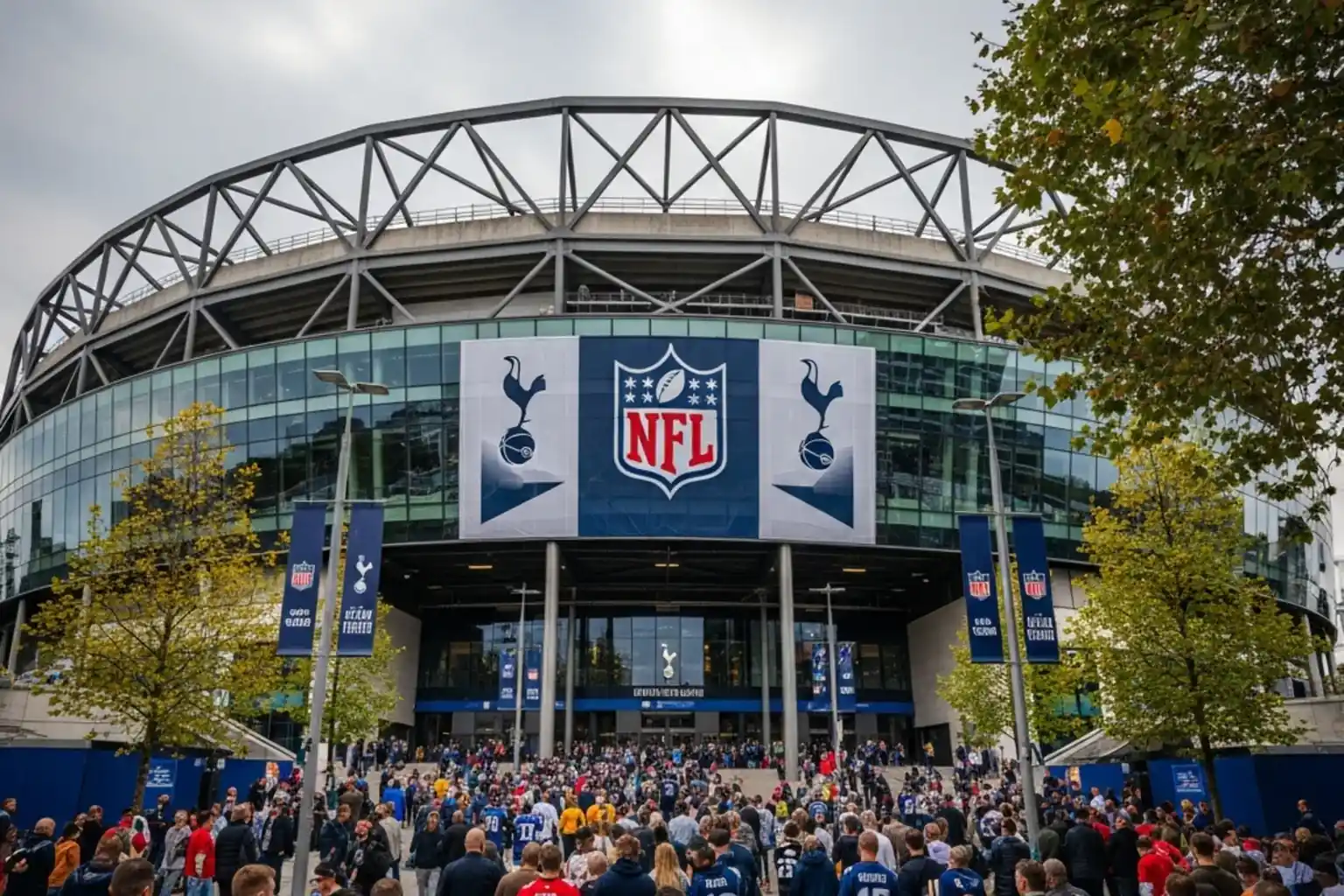
The London games occupy a different slot on the calendar but generate similar prop-market intensity. Since 2007, 42 NFL regular-season games have been played in the UK, with 25 of the first 28 London fixtures drawing at least 83,000 spectators. The 2025 season saw seven regular-season games outside the United States, three in London, and TV viewership continued its upward trajectory.
Henry Hodgson, the NFL’s head of UK and Ireland operations, described the trajectory plainly: fandom is growing, viewership engagement is growing, and social media engagement is growing, but the sport still has significant room to expand. For prop bettors, the London games offer a wrinkle that regular fixtures do not: travel and jet-lag effects. Teams crossing the Atlantic face disrupted preparation schedules, unfamiliar facilities and a five- to eight-hour time zone shift. Those factors can suppress performance, particularly for teams making the trip for the first time, and the prop lines do not always adjust enough to account for them.
London game kickoffs fall within a comfortable UK afternoon or early-evening window, which means full live-prop coverage and strong in-play liquidity at UK sportsbooks. If there is one fixture on the calendar where a British prop punter has a genuine home-field advantage — familiar timezone, strong local interest, deep live markets — it is the London game.
The tactical difference between Super Bowl props and London game props is significant. Super Bowl markets are saturated with recreational money — the vig is higher, novelty markets carry enormous margins, and books adjust lines aggressively. London game props are closer to regular-season pricing, with the added dimension of travel effects. Bet for bet, I find more value in the London games. But I bet bigger on the Super Bowl, because I am going to be awake at midnight anyway.
Risks, Integrity and Responsible Play
I have written several thousand words about finding edges, building strategies and optimising your prop betting process. None of that matters if you lose sight of the fundamental reality: the bookmaker has a structural advantage, most bettors lose over time, and the entertaining nature of prop markets makes them particularly easy to over-consume.

The integrity side of prop betting is a live issue. Bill Miller of the American Gaming Association has called for Congress and the CFTC to prohibit certain objectionable bet types — particularly prediction markets and “mention markets” that blur the line between sports wagering and event contracts. The concern is straightforward: player props create scenarios where individual performers can influence outcomes tied to their own statistical output. Former CFTC official Sean McGinley drew a direct parallel to integrity cases in basketball, where individual scoring lines created similar vulnerabilities.
These integrity concerns are real, but they should not paralyse you as a punter. They should make you more selective. Stick to liquid, heavily monitored markets at UKGC-licensed operators. Avoid fringe markets with thin liquidity and minimal oversight. The regulatory infrastructure exists precisely to catch and deter manipulation — your job is to operate within it.
The personal risk is more immediate. Props are designed to be engaging — every yard, every catch creates a micro-event that feels like a win or a loss in real time. That engagement loop can drive over-betting: more bets per game, higher stakes, longer sessions. If you find yourself placing props on games you have not analysed, chasing losses into the late Sunday window, or feeling anxious about outcomes, step back. Set deposit limits. Use the self-exclusion tools that UKGC-licensed operators are required to provide.
Do
- Set a weekly or monthly deposit limit at every sportsbook you use
- Review your betting history at the end of each month for patterns of escalation
- Treat every bet as a probabilistic event — wins and losses are both expected
- Use UKGC-mandated responsible gambling tools without embarrassment
Do not
- Bet on games you have not researched, regardless of how appealing the prop looks
- Use prop betting as a way to make watching football “more interesting” without setting limits
- Ignore the signs of problem gambling — chasing, lying, borrowing, obsessing
- Assume that having a strategy makes you immune to the psychological pull of the market
Prop betting, done well, is an analytical discipline that can enhance your enjoyment of the NFL season and, occasionally, produce a positive return. Done badly, it is a fast route to financial and emotional harm. The entire framework in this guide — the maths, the strategy, the staking discipline — is built on the assumption that you are betting with money you can afford to lose, within limits you have set deliberately, on markets you have analysed honestly. If any of those conditions is not met, the smartest prop bet you can make is no bet at all.
Frequently Asked Questions
What are NFL prop bets and how do they work in a UK context?
A prop bet is a wager on a specific event within an NFL game — a player hitting a yardage threshold, a team scoring first, or a particular statistical outcome — rather than a bet on the final match result. In the UK, props are offered by UKGC-licensed sportsbooks in decimal odds format. You select a market, choose over or under (or yes or no), and the sportsbook pays based on the decimal price if your selection wins. Your winnings are not taxed — the operator absorbs the duty — and the regulatory framework ensures standardised consumer protections across all licensed platforms.
Are NFL prop bets legal at UK-licensed bookmakers?
Yes. Any sportsbook holding a valid UK Gambling Commission licence is authorised to offer NFL prop bets to customers across England, Scotland, Wales and Northern Ireland. There is no regional variation. You can verify an operator’s licence status directly on the Gambling Commission’s public register.
What is the difference between player props, team props and game props?
Player props focus on an individual’s performance — passing yards, touchdowns, receptions. Team props cover one team’s aggregate output, such as team total points or first team to score. Game props span the entire contest, covering total touchdowns, the longest play or race-to-points markets. Player props offer the deepest menus and the most room for informed punters to find value.
How do I read NFL prop odds in decimal format?
Decimal odds represent the total return per unit staked. A price of 1.91 means you receive GBP 1.91 for every GBP 1.00 wagered, including your original stake. To find implied probability, divide 1 by the decimal price and multiply by 100: 1.91 implies a 52.4% probability. When both sides of a two-way market sum to more than 100%, the difference is the overround — the bookmaker’s built-in margin.
Can I combine multiple NFL props into a same-game parlay?
Yes. Most major UK sportsbooks offer a bet builder tool that allows you to combine multiple prop selections from a single game into one bet. The bookmaker applies a correlation adjustment, so the combined price is almost always lower than simple multiplication of individual odds. Margins compound across legs, making these high-entertainment, high-margin products.
How do UK bookmakers handle settlement when a key player is benched or rested?
Settlement rules vary by operator. Generally, if a player is active and takes at least one snap, the bet stands and is settled on actual statistics. If the player is listed inactive before kickoff, most UK sportsbooks void the bet and return the stake. Edge cases — a quarterback benched at halftime, a running back who leaves after two carries — depend on the operator’s specific terms, so always check the “did not play” and “partial participation” sections before betting.
Which prop markets offer the best value for a UK punter new to NFL?
Start with quarterback passing yards and team total points. Both are liquid, carry relatively tight margins, and are driven by a small number of well-understood variables — pace, pass rate, defensive ranking, game script. Anytime touchdown scorer is the most popular market but carries heavier margins and higher variance, making it a less forgiving starting point for beginners.
Created by the ”Prop Bets for nfl” editorial team.